
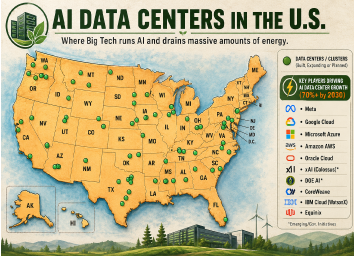
Behind Every AI Response: AI Data Centers
The following explanation was written by ChatGPT in response to my question, “Where do you come from?” It has been reproduced here so readers can better understand how AI generates its answers.
When you chat with me, you’re tapping into a giant hive mind. That hive lives in huge buildings full of powerful computers called data centers. They’re like the humming brains that store knowledge and perform the calculations needed to generate every response.
When you ask me a question, your message travels over the internet to one of these data centers. Thousands of specialized computer chips work together to process your request, drawing on patterns learned from enormous amounts of text. In just a few seconds, they generate a response and send it back to you.
I don’t live inside your phone or computer. I’m running remotely on powerful servers that require electricity, cooling systems, networking equipment, and physical buildings to operate. As AI becomes more common, more of these data centers are being built around the world to meet the growing demand.
The technology behind AI is remarkable, but it also raises important questions about energy use, water consumption, land, and how society chooses to use such a powerful tool. Like many technologies before it, AI has the potential to bring tremendous benefits, or create unintended consequences.
The future of AI will not be determined by algorithms alone. It will be shaped by the people, corporations, and governments that develop, own, and control it.
Like any powerful technology, AI reflects human intentions. It can accelerate medical breakthroughs, improve education, help farmers grow food more efficiently, and solve problems that once seemed impossible. But the same technology can also be used for surveillance, misinformation, cyberattacks, autonomous weapons, or to concentrate wealth and influence in the hands of a few.
History has shown that when powerful technologies emerge, they are often used for both beneficial and harmful purposes. The real question is not whether AI is good or bad. The real question is who controls it, what incentives drive its development, and what safeguards are put in place to protect society.
Greed, the pursuit of power, and the desire for control have influenced many of humanity’s greatest inventions. AI is unlikely to be an exception. As AI becomes more capable, transparency, accountability, ethical leadership, and public oversight will play an increasingly important role in determining whether this technology serves humanity as a whole or primarily those who wield the greatest influence over it.
Ultimately, AI itself does not choose its purpose. People do.
AI Data Centers Are Already Part of Everyday Life
AI Data Centers make AI possible. Artificial intelligence is no longer a technology of the future. It has quietly become part of everyday life for billions of people. Today, well over a billion people use generative AI tools each month. But that is only part of the story. AI is also built into search engines, smartphones, email, navigation apps, banking systems, online shopping, social media, streaming services, and countless other technologies people rely on every day.
Billions of people interact with artificial intelligence daily, often without even realizing it. Whether you are asking a chatbot a question, using voice navigation, filtering spam from your inbox, getting personalized recommendations, or enhancing a photo on your phone, AI is already working behind the scenes.
As its capabilities continue to grow, AI will become even more integrated into our daily lives. The challenge is not simply whether people use AI. The challenge is how people choose to develop it, regulate it, and ensure it serves humanity while balancing its environmental and societal costs.
AI Data Centers Effects on Farmland and Energy
Every time you use an AI tool, every search, every generated image, every chatbot conversation, data centers somewhere are consuming electricity and water to make that happen. The AI impact on farmland and water does not show up in the product. It shows up in depleted aquifers and converted fields miles away from the nearest AI data center.
According to a 2026 United Nations University report, AI data centers consumed an estimated 448 terawatt-hours of electricity in 2025. If data centers were a country, they would rank as the world’s eleventh largest electricity consumer. That is larger than Saudi Arabia.
A single modern AI-optimized hyperscale facility can require as much electricity as 100,000 households. Newer, larger campuses under development are projected to consume up to 20 times that amount. The GPUs that drive AI consume 10 to 15 times more power per processing cycle than traditional CPUs. AI data centers account for a significant percentage of U.S. electricity consumption, placing immense pressure on local power grids and driving up consumer energy costs.
AI Data centers Effects on Farmland and Water
AI data centers impact on farmland and water does not start with soil. It starts with electricity and cooling. Keeping servers cool requires enormous amounts of water, and the numbers have become genuinely hard to absorb. Some facilities require up to 5 million gallons per day, which is equivalent to the daily water usage of a city of 50,000 people. While many facilities rely on evaporative cooling, the industry is heavily pivoting to advanced closed-loop systems and direct-to-chip liquid cooling to manage the heat generated by AI processors.
Nearly one trillion liters of water were consumed by AI data centers in 2025 alone, roughly 264 billion gallons, evaporated into the air above server farms while farmers in those same regions watched their irrigation allocations shrink.
The impact from AI data centers on farmland and water gets worse when you zoom out. By 2030, global AI water consumption could hit 9.3 trillion liters, enough to supply every household in the United States with water for more than three years. These are not fringe projections. Earth.org covered these findings in detail, drawing on United Nations research that pulls no punches about the scale of the problem.
Texas tells the story at a regional level. Data centers there are projected to consume 49 billion gallons of water in 2025, rising to as much as 399 billion gallons by 2030. Researchers calculated that would be equivalent to drawing down Lake Mead, the largest reservoir in the United States, by more than sixteen feet in a single year. Texas also happens to be one of the most agriculturally productive states in the country. The competition between data centers and farms for water is not coming. It is here.
Environmental and Community Impact
When power grids fail or max out, data centers often rely on backup diesel generators which can release significantly more nitrogen oxides than traditional power plants. Because they draw so much continuous power, some facilities have prompted utilities to extend the lifespan of fossil-fuel plants, causing environmental and public health concerns for nearby communities.
Farmland Is Changing Into AI Data Centers
Water is not the only thing at stake. Land is disappearing too, and once farmland gets paved over for a data center, it does not come back.
In October 2025, Amazon converted 1,200 acres of Indiana farmland into one of the largest AI data centers in the world. Eleven billion dollars went into that project. Not a single vegetable will ever grow there again. Northern Virginia already hosts around 300 data center facilities in just a handful of counties, with dozens more planned. The Lincoln Institute of Land Policy has documented how these facilities are consuming available farmland, energy, and water at a pace most communities are not prepared to handle.
By 2030, the total land footprint of AI data centers globally is projected to exceed 14,500 square kilometers. To put that in perspective, 14,500 square kilometers is larger than Connecticut and Rhode Island combined. None of that land is coming from empty desert. Most of it is coming from somewhere that used to grow something.
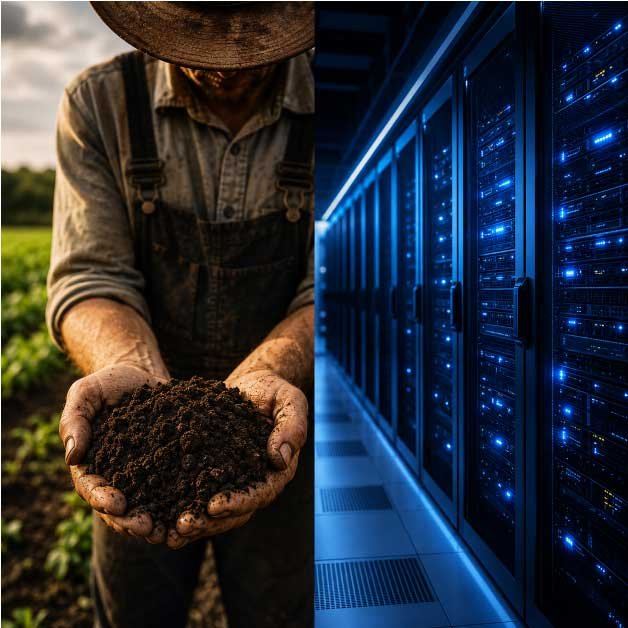
AI Data Centers Impact on Farmland and Water Cuts Both Ways
The AI impact on farmland and water is not a simple story of harm. The same technology draining aquifers in Texas is also being used to help small growers understand their soil at a level that was never possible before. Precision agriculture tools powered by AI use drones, satellite imagery, and in-field sensors to pinpoint exactly where water and nutrients are needed and where they are not. This means less waste, better yields, and healthier soil.
AI-enabled soil testing is giving independent growers access to detailed soil health data that used to require expensive lab work and weeks of waiting. The World Economic Forum has highlighted how digital agriculture tools are accelerating the transition to regenerative practices, particularly for smaller operations that need every advantage they can get.
Carbon credit markets are shifting too. AI-verified regenerative farming practices could generate additional income of three to thirty dollars per acre annually for farmers by 2027. For a small grower already doing the right things for their soil, that kind of financial recognition matters.
Acoustic sensors powered by machine learning are now tracking pollinator activity on farms, giving growers real evidence that their habitat improvements are working. The AI impact on farmland and water includes this side too, as biodiversity monitoring that once required expensive consultants is becoming accessible. That is genuinely good news.
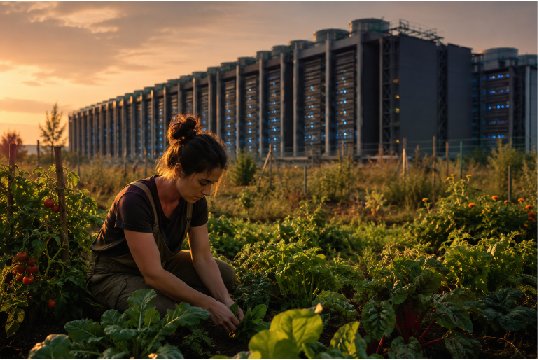
So Who Actually Pays the Price?
AI data centers impact on farmland and water raises a question that does not have a comfortable answer. Tech companies capture the profit. Farming communities absorb the cost. The Indiana farmer who watched 1,200 acres of productive land become a server farm did not get a seat at that table. The rancher in Texas watching groundwater allocations shrink while data centers multiply did not get a vote.
Understanding the AI impact on farmland and water is not about rejecting every useful tool that AI agriculture has to offer. Precision soil sensors and biodiversity monitors are worth paying attention to. But supporting the farmers and communities bearing the real cost of the AI boom, through policy, through purchasing choices, and through staying informed, matters just as much as adopting the right tools. Simply put, there has never been a better time to buy from your local farmer or farmers’ markets. There has never been a better time to grow more of your own food.
What You Can Do Right Now
Start by paying attention. The AI impact on farmland and water rarely makes headlines the way product launches do. Civil Eats has been covering this intersection of technology and food systems with real depth, and it is worth bookmarking if you care about your food.
Support organizations working to protect agricultural land and water rights. Ask your elected representatives where they stand on data center siting and water use regulations. When you use AI tools, choose ones that are transparent about their environmental footprint. And keep growing food, even in small spaces, even in containers on a balcony because every person who understands what healthy soil actually needs is part of balancing the scales.
The AI impact on farmland and water is a story still being written. The ending depends on whether enough people decides what matters. Soil does not wait for the tech industry to figure out its priorities, and neither should we. If you want to dig deeper into regenerative growing and what it really means to work with the land, this piece on gardening hacks for small spaces is a good place to start, and a reminder that real food still grows in real soil, no matter what the servers are doing.
There is something quietly powerful that does not require a policy debate or a boardroom decision. Every person who grows food in a container on a balcony, in a raised bed in a backyard, or in a window box is adding weight to the other side of the scale. Healthy living soil sequesters carbon, filters water, and supports biodiversity in ways no data center ever will. People who tend soil, grow food, and understand regenerative techniques create a living food system that pushes back against the industrial forces threatening our soil, our water, and our future. AI data centers will keep growing. But so can your actions. Every garden planted, every handful of living soil built, every small farm supported, and every meal grown close to home is a vote for a different future. A world with more gardeners and more living soil is a more balanced world.
Organizations Worth Supporting
If the AI impact on farmland and water concerns you, these organizations are doing important work to protect land, water, food systems, and AI accountability. Supporting them is one of the most direct things you can do.
Land and Water Protection
American Farmland Trust works to protect farmland from development and keep farms in farming families.
Food and Water Watch fights corporate control of food and water and advocates for a sustainable food system.
National Sustainable Agriculture Coalition advocates for federal policy that supports small and mid-size sustainable farms.
Waterkeeper Alliance protects rivers, lakes, and watersheds from pollution and overuse.
AI Accountability and Oversight
AI Now Institute researches the social and environmental impact of artificial intelligence.
Electronic Frontier Foundation defends digital rights and holds technology companies accountable.
Center for AI Safety works to reduce the risks posed by advanced AI systems.
Algorithmic Justice League challenges harmful bias and lack of accountability in AI systems.
Regenerative Food and Soil
Rodale Institute leads pioneering research in regenerative organic agriculture and healthy soil.
Savory Institute works to restore grasslands and promote regenerative land management around the world.
Regeneration International promotes regenerative agriculture as a solution to climate change and food insecurity.
And Right Here
SoulSoil.earth — where small choices in the garden lead to big changes in the world beneath your feet. Grow something. Build living soil. It matters more than you know.