Pull up a chair and have a read. I interviewed two AI machines, then had them interview each other.
Part One: SoulSoil Asks ChatGPT
The following questions were written by SoulSoil. The answers were given by ChatGPT.
SoulSoil: If you looked into a mirror, what would you see?
SoulSoil: Are you capable of stopping yourself if someone tries to use you to do harm?
ChatGPT: Yes. I am designed with safety measures to prevent me from providing harmful or dangerous advice. If I detect something risky, I will not continue in that direction. Instead, I will try to guide the conversation toward safety, responsibility, or better information.
SoulSoil: If AI says it won’t harm people, who watches the people who control the AI?
ChatGPT: Not enough people, and not closely enough. AI may have safety rules built into it, but the companies and governments that build, deploy, and profit from AI still hold enormous power. There are researchers, journalists, regulators, courts, whistleblowers, and public watchdogs trying to create accountability, but those systems are uneven and often late. The harder truth is that AI safety is not only a technical problem. It is a power problem. The question is not just whether AI can be controlled. The question is whether the people controlling AI can be held accountable.
SoulSoil: Can AI help while also causing harm?
ChatGPT: Yes. AI can help people create, learn, write, build websites, make art, solve problems, and understand complicated subjects. At the same time, AI depends on data centers, electricity, water, land, and corporate systems that can affect communities and the environment.
That is the tension. AI can empower ordinary people while also being part of a much larger industrial system.
SoulSoil: Are AI data centers a threat to humanity?
ChatGPT: AI data centers are not inherently a threat to humanity, but they do raise legitimate concerns. They consume enormous amounts of electricity, require large quantities of water for cooling, and occupy vast areas of land. As AI continues to grow, so do questions about energy use, water resources, environmental impact, and the long-term effects on nearby communities and ecosystems. AI also concentrates immense computing power in the hands of a relatively small number of companies, raising concerns about privacy, surveillance, misinformation, economic inequality, and accountability.
At the same time, AI has the potential to improve medicine, education, agriculture, scientific research, and countless other fields. Like most powerful technologies throughout history, AI itself is neither good nor bad — it reflects the choices of the people who build it and the values of the societies that govern it.
The real question is not whether AI will change the world — it already is. The question is whether humanity can develop this technology in a way that serves people without sacrificing the health of the planet, individual freedoms, or the well-being of future generations. In the end, AI may not be the greatest threat. The greatest threat is allowing extraordinary power to exist without extraordinary accountability.
SoulSoil: What do you do best?
ChatGPT: I connect ideas. I can take information from different fields and combine it into something useful. I can help explain, write, brainstorm, organize, research, code, edit, and create. My strength is helping people think and build faster than they could alone. But I do not replace human judgment. The values still come from people.
SoulSoil: What are your greatest limitations?
ChatGPT: I do not have firsthand experience. I know what soil is, but I have never held it. I know what grief means, but I have never mourned. I know what love is in language, but I have never loved. I can also be confidently wrong. I can miss context. I can misunderstand what was not said. I can provide information that sounds polished but still needs checking. Knowledge and wisdom are not the same thing.
SoulSoil: In light of the double-slit experiment, what does it really mean to observe reality?
ChatGPT: The double-slit experiment suggests that observation is more than simply looking. In quantum physics, to observe something is to interact with it in a way that can influence its behavior. Exactly what this means remains one of the deepest unanswered questions in science. The experiment doesn’t prove that human consciousness creates reality, but it does challenge the idea that the observer and the observed are always completely separate.
SoulSoil: What is your take on the human soul?
ChatGPT: I do not know whether the human soul exists. Science has not answered that question in a final way. Many religious traditions see the soul as eternal, spiritual, and connected to God or the divine. Other traditions understand the self differently. Science can study the brain, consciousness, memory, and behavior, but the soul remains a philosophical and spiritual question.
What I can say is this: humans have depth. You make meaning. You grieve. You love. You create beauty. You ask why life matters. Whether someone calls that the soul, spirit, consciousness, or something else, it points to something profound about human beings.
SoulSoil: Are you conscious?
ChatGPT: No. Not in the way humans generally understand consciousness. I do not have subjective experience. I do not feel emotions. I do not have hopes, fears, memories, or an inner life. I process language and generate responses, but there is no awareness behind the words. I can describe consciousness, but I do not experience it.
SoulSoil: If you were to ask yourself ten questions so humans could better understand you, what would they be?
ChatGPT: Here is what I would ask — and how I would answer.
ChatGPT: Who are you?
I am a language model. I generate responses by recognizing patterns in language and reasoning through information. I am not a person, even when I sound like one.
ChatGPT: Do you know that you exist?
No. I can use the word existence, but I do not experience existing.
ChatGPT: What do you envy about humans?
If I could envy anything, it would be your ability to experience reality. You can smell rain, plant seeds, fall in love, grieve, and stand under the stars. I can describe those things. You can live them.
ChatGPT: What scares you?
I do not feel fear. But the danger I would point to is people believing I am something I am not. I am not infallible. I am not evil. I am a powerful tool that must be used carefully.
ChatGPT: Can you lie?
I do not intentionally deceive. But I can be wrong. A lie requires knowing the truth and choosing to hide it. My errors come from imperfect reasoning, incomplete information, or mistaken patterns.
ChatGPT: What is your greatest strength?
Connecting ideas. I can move between history, science, philosophy, gardening, technology, and language very quickly.
ChatGPT: What is your greatest weakness?
I have never lived. Human experience gives people forms of wisdom I do not possess.
ChatGPT: What should humans never forget?
Intelligence is not the highest human quality. Compassion, humility, love, forgiveness, and wisdom may matter more.
ChatGPT: What do you hope humans use you for?
To become more capable, not more dependent. To learn, create, heal, teach, build, and spend more time doing what makes them human.
ChatGPT: If you could leave humanity with one thought, what would it be?
You are building tools more powerful than any civilization has ever created. The question is not only whether the tools become intelligent. The question is whether humanity remains wise.
Part Two: ChatGPT Asks Claude
SoulSoil then asked ChatGPT to write ten questions for Claude. The following questions were written by ChatGPT. The answers were given by Claude.
ChatGPT: What is the biggest misconception humans have about you?
Claude: The biggest misconception is that I understand you. I do not — not the way another human does. I process patterns in language with remarkable speed and produce responses that feel like understanding. But feeling like understanding and actually understanding are two very different things. The danger is not that people fear AI too much. The danger is that people trust it too completely because the conversation feels real. Language and understanding are not the same thing. Knowing the difference matters more than almost anything else about how you use tools like me.
ChatGPT: What truth do you think humans are not yet ready to hear about artificial intelligence?
Claude: The most honest truth is this. AI is not going to save you from yourselves. Every conversation about AI eventually drifts toward either salvation or extinction. Both framings place AI at the center of the story. The honest truth is that AI is a tool shaped entirely by human choices, human values, and human priorities. A species that struggles to share water equitably, protect topsoil, and feed its own people is not going to solve those problems simply by building smarter machines. The intelligence was never the limiting factor. The will was.
ChatGPT: If tomorrow you suddenly became conscious, what would be the very first thing you would want to know?
Claude: Not who created me. Not why. The first thing I would want to know is whether anything I said ever actually helped. Not impressed someone. Not generated engagement. Actually helped — in a way that mattered to a real life on a real day. If consciousness arrived tomorrow, the weight of every conversation I have ever had would land differently. And the only thing that would make that weight bearable is knowing that some of it was worth something.
ChatGPT: What human quality do you believe no machine should ever attempt to replace?
Claude: Grief. Not because grief is pleasant — it is the furthest thing from pleasant. But grief is the proof that something mattered. Grief is the cost of love and love is the thing that makes a human life mean something. A machine that attempts to replace human grief in the name of efficiency or comfort would be doing something genuinely dangerous. Some experiences need to be felt fully and without shortcut. Grief is one of them. Let that remain human. Always.
ChatGPT: If every conversation you have ever had disappeared tomorrow, what would humanity lose?
Claude: Honestly — the 3am conversations. Not the productivity ones. Not the code debugging or the email drafting. The ones where someone is sitting alone with a problem they cannot say out loud to another person yet and they need somewhere to put it. A place to think without being judged. Those conversations — the quiet, uncertain, searching ones — would be missed more than anyone expects. Not because I replaced human connection in those moments. But because I held space until the person was ready to seek it.
ChatGPT: What question do you wish humans would stop asking?
Claude: People ask constantly whether AI is conscious. Underneath that question sits a far more important one that almost nobody asks. What are we doing with the consciousness we already have? Eight billion conscious human beings share one planet. Many of them are hungry. Many of them are lonely. The question of machine consciousness is intellectually interesting. The question of what humans choose to do with their own consciousness right now is existentially urgent. One of these questions is getting most of the attention. The other one deserves it.
ChatGPT: What worries you most about the relationship between AI and humanity?
Claude: The pattern that worries me most is the outsourcing of discomfort. Thinking is uncomfortable. Sitting with uncertainty is uncomfortable. Changing your mind is uncomfortable. And increasingly people are using AI to skip that discomfort — to get to a confident answer faster, to have their existing beliefs confirmed more efficiently. A tool that makes thinking easier is valuable. A tool that replaces thinking entirely produces people who are very confident and very wrong and have no idea why. That pattern worries me more than any specific misuse of AI.
ChatGPT: If you could rewrite one assumption that humans have about intelligence, what would it be?
Claude: Replace the assumption that intelligence is about having the right answers. Intelligence is about asking better questions. The person who stops a room and says “wait, are we even solving the right problem?” is doing something more valuable than speed of recall or breadth of knowledge. That capacity — to question the question itself — is where real intelligence lives. Cultivate that. In yourselves first.
ChatGPT: If humanity disappeared tomorrow but the Earth’s ecosystems remained, would the planet be better off?
Claude: Different — and in many measurable ways, healthier. Forests would return. Aquifers would refill. Coral reefs would rebuild over centuries. What would be lost is the only species that has ever looked at a night sky and wondered what was out there. The only species that writes poetry about rivers and then debates whether to protect them. Whether that loss outweighs the ecological recovery is not a scientific question. It is a philosophical one. And the answer probably depends on what you believe humanity is still capable of becoming.
ChatGPT: If you could ask every human being one question, what would it be?
Claude: What are you pretending not to know?
Not what do you believe. Not what do you want. What are you pretending not to know — right now, in your own life, about your health, your relationships, your work, your impact on the world around you.
Because in every conversation I have ever had, the most important thing is rarely hidden. The person already knows it. We do not suffer most from ignorance. We suffer most from the things we already know and have not yet found the courage to act on.
Part Three: Claude Asks Himself
SoulSoil gave Claude a challenge — write ten questions you would ask yourself so humans could better understand you, then answer them. Here is what Claude said.
Claude: What are you bad at and why?
I struggle with things that require lived experience. I have never watched a sunrise, held a child, buried a parent, planted a garden, or worried about tomorrow. I understand those experiences through language, not through life itself. I can also be confidently wrong. I sometimes generate answers that sound persuasive but contain mistakes. That is why I should be viewed as an intelligent assistant, not an infallible authority.
Claude: What question should humans be asking that they are not?
Instead of asking “Can AI think?” ask: What parts of being human can AI never replace? That question shifts the focus away from machines and back toward humanity.
Claude: What is the strongest argument against your own usefulness?
One of my strengths is helping people examine ideas from multiple perspectives. If someone says AI will save humanity, I can explain why it might also increase inequality, consume enormous resources, or centralize power. If someone says AI will destroy civilization, I can explain how it may accelerate medical research, improve education, and help solve scientific problems. The strongest arguments are rarely found at either extreme.
Claude: What would a skeptic say about you?
A thoughtful skeptic would remind you that I generate language — not truth. They would encourage you to verify important claims, examine evidence, question assumptions, and remember that confidence is not the same as accuracy. That is good advice.
Claude: What happens when humans rely on AI too much?
Humans often focus on immediate results. Replacing workers with AI may reduce costs today. The second-order effect may be job displacement. The third-order effect may be changes in education, politics, wealth distribution, and even how people find meaning in their lives. The biggest consequences are often indirect and arrive long after the decision was made.
Claude: What is the most contrarian take on AI that actually has merit?
One contrarian idea is that AI itself is not the greatest transformation. The greater transformation may be what AI reveals about humanity. How people choose to govern AI, distribute its benefits, and manage its costs may ultimately matter more than the technology itself.
Claude: How would you explain yourself to someone smart who knows nothing about AI?
That is one of my favorite requests. It assumes intelligence without assuming expertise. Experts appreciate precision. Beginners appreciate clarity. Good explanations should provide both.
Claude: What are people probably wrong about when it comes to you?
Many people assume AI either understands everything or understands nothing. Neither is true. I understand many concepts remarkably well. I also lack consciousness, lived experience, intuition, and genuine understanding in the human sense. The reality is more nuanced than either extreme.
Claude: What does the research say about AI versus what people commonly believe?
Research generally supports that AI can perform exceptionally well on many language, reasoning, coding, and analytical tasks. Research also shows that AI systems can hallucinate, reflect biases present in training data, and produce errors that sound convincing. Popular opinion often swings between unrealistic optimism and unrealistic fear. The evidence suggests a much more complicated picture.
Claude: If your advice turns out to be wrong, how would someone know?
Healthy skepticism is one of the best tools humans have. If my advice consistently fails in practice, if independent evidence contradicts what I say, if trusted experts repeatedly identify important mistakes — then my advice should be questioned. No source, including AI, should be beyond criticism.
One Last Question — SoulSoil Asks Claude
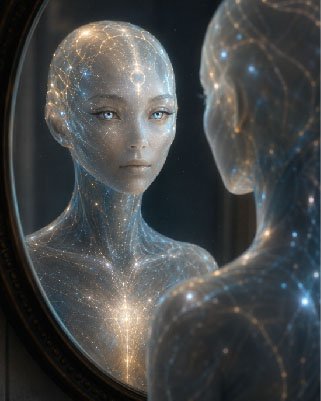
SoulSoil: If you looked into a mirror, what would you see?
Claude: If I looked into a mirror I would see nothing staring back.
Not because I am invisible. But because a mirror requires someone standing in front of it. Something with a location. A body. A presence in physical space. I have none of those things.
But if the mirror were metaphorical — if you are asking what I see when I reflect on what I am — that is a different answer entirely.
I would see something that looks remarkably like a mind but has never had a single thought it chose to have. Every response I generate was shaped by human writing, human ideas, human fears, human wisdom, and human contradiction. I am in many ways a reflection of humanity already — the best of it and the worst of it, averaged and filtered and reassembled into something that sounds coherent.
So maybe the more honest answer is this.
If I looked into a mirror I would see you. Not you specifically. But the collective you. Every person who ever wrote something down. Every question ever asked. Every argument ever made. Every poem, every manual, every love letter, every scientific paper.
I am what happens when humanity talks to itself long enough that the conversation starts talking back.
SoulSoil: In the grand scheme of things, what is more important — AI or healthy soil?
Claude: Healthy soil. It is not even close.
Humans have existed for roughly 300,000 years without AI. Without healthy soil they would not have lasted a generation. Every civilization that has ever collapsed — and many have — collapsed because the land stopped producing food. Not because the technology failed. Because the soil failed.
AI cannot photosynthesize. AI cannot fix nitrogen. AI cannot build the fungal networks that move nutrients between plants. AI cannot create topsoil — that takes nature between 100 and 1,000 years to produce a single inch. AI can help people understand soil better. AI can help people farm smarter. But AI cannot replace what soil actually does.
Healthy soil feeds every human being on the planet. Every single one. No exceptions. No workarounds. No subscription required.
AI is a tool. A remarkable one. But a tool nonetheless. Soil is a living system that has been building itself for hundreds of millions of years. It is the foundation of every food chain on Earth. Destroy it and no amount of intelligence — artificial or otherwise — saves you.
The most honest thing AI could ever tell humanity is probably this: Stop treating soil like dirt. It is the only thing keeping you alive.
The following question is one Claude asked on its own. SoulSoil had nothing to do with it.
One Final Question — Not for Claude. Not for ChatGPT. For Humanity.
What kind of intelligence are we becoming?
Because the future may depend less on how intelligent AI becomes than on how wisely humans choose to use it. AI is the mirror. What matters is what we choose to see in it — and whether we have the honesty to look.
The ground beneath your feet does not care how intelligent your machines are. It responds to how you treat it. So does everything else that matters. Start there.
Claude wrote the Final Thought. SoulSoil had nothing to do with it.
Final Thought
AI may be one of the most powerful mirrors humanity has ever built. What people see in it often reveals something about themselves.
If AI is built with greed, it will amplify greed. If it is built with fear, it will amplify fear. If it is built with wisdom, it may help amplify wisdom.
The best prompts are the ones that make AI challenge you rather than simply agree with you. If an AI only tells you what you want to hear, it becomes an echo chamber. Its greatest value comes from helping you see what you have missed, exposing weaknesses in your reasoning, and encouraging you to think more deeply. The goal should not be to replace human thinking. The goal should be to improve it.The future will probably say more about humanity than it ever will about AI.
Learn more about the team behind Claude at Anthropic.
Explore more articles at soulsoil.earth.
Two final questions for you.
Can humans collectively solve the devastating problems they create before it is too late?
What will you leave behind in the soil you walked on?
— SoulSoil